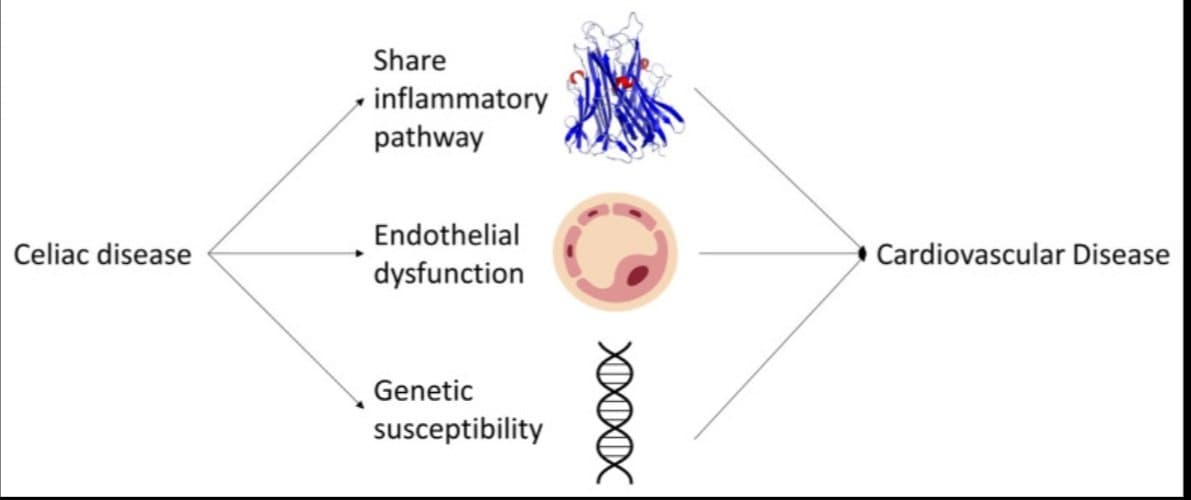
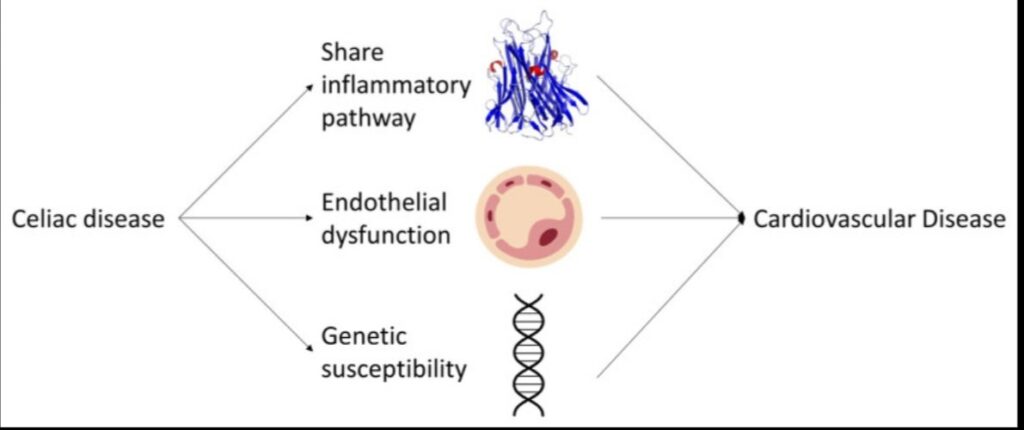
Müasir zamanların xəstəlikləri olan bu iki xəstəlik bir birinə çox oxşasada bəzi fərqləri olmaqdadır. Bu yayınımızda xəstəliklərin ürək damar problemləri ilə əlaqəsini göstərən əlaqə haqqında yazırıq.İngiltərədə təqribən 500000 min insan üzərində aparılmış böyük randomizə olunmuş bir tədqiqat belə əlaqənin olmasını daha aydın göstərir. Seliak xəstəliyinin baş vermə səbəbi autoimmun patologiya nəticəsində yaranmış xroniki iltihab eyni zamanda arteriyalarda aterosklerotik dəyişikliklərin artmasına səbəb olur. Nəticədə kardiovaskulyar xəstəliklərin və gələcəkdə onların ola biləcək ağırlaşmalarının daha sıx üzə çıxması müşahidə olunur. Bu zaman xroniki iltihabdan başqa həmdə genetik əlaqənin də olması prosesin inkişafına təsir edir. Seliak xəstələrinin pəhrizə əməl etmələri isə həm də Kardiovaskulyar xəstəliklərin yaranma riskini azalda bilər.
Association between coeliac disease and cardiovascular disease: prospective analysis of UK Biobank data
Author affiliations•Megan Conroy1
 ,Naomi Allen1 2,Ben Lacey1,Elizabeth Soilleux3,Thomas Littlejohns1
Abstract
Objectives To investigate whether people with coeliac disease are at increased risk of cardiovascular disease, including ischaemic heart disease, myocardial infarction, and stroke.
Design Prospective analysis of a large cohort study.
Setting UK Biobank database.
Participants 469 095 adults, of which 2083 had coeliac disease, aged 40-69 years from England, Scotland, and Wales between 2006 and 2010 without cardiovascular disease at baseline.
Main outcome measure A composite primary outcome was relative risk of cardiovascular disease, ischaemic heart disease, myocardial infarction, and stroke in people with coeliac disease compared with people who do not have coeliac disease, assessed using Cox proportional hazard models.
Results 40 687 incident cardiovascular disease events occurred over a median follow-up of 12.4 years (interquartile range 11.5-13.1), with 218 events among people with coeliac disease. Participants with coeliac disease were more likely to have a lower body mass index and systolic blood pressure, less likely to smoke, and more likely to have an ideal cardiovascular risk score than people who do not have coeliac disease. Despite this, participants with coeliac disease had an incidence rate of 9.0 cardiovascular disease cases per 1000 person years (95% confidence interval 7.9 to 10.3) compared with 7.4 per 1000 person years (7.3 to 7.4) in people with no coeliac disease. Coeliac disease was associated with an increased risk of cardiovascular disease (hazard ratio 1.27 (95% confidence interval 1.11 to 1.45)), which was not influenced by adjusting for lifestyle factors (1.27 (1.11 to 1.45)), but was strengthened by further adjusting for other cardiovascular risk factors (1.44 (1.26 to 1.65)). Similar associations were identified for ischaemic heart disease and myocardial infarction but fewer stroke events were reported and no evidence of an association between coeliac disease and risk of stroke.
Conclusions Individuals with coeliac disease had a lower prevalence of traditional cardiovascular risk factors but had a higher risk of developing cardiovascular disease than did people with no coeliac disease. Cardiovascular risk scores used in clinical practice might therefore not adequately capture the excess risk of cardiovascular disease in people with coeliac disease, and clinicians should be aware of the need to optimise cardiovascular health in this population.Back to top
What is already known on this topic
- Evidence is conflicting on whether coeliac disease is associated with a higher risk of cardiovascular disease, with previous research being conducted in small cohorts or using registry data sources with limited sociodemographic and lifestyle data
- Previous studies have tended not to take traditional cardiovascular risk factors, such as blood pressure or serum total cholesterol, into account when examining the association between coeliac disease and cardiovascular disease, despite research showing a healthier cardiovascular profile in people with coeliac disease
What this study adds
- Individuals with coeliac disease had a lower prevalence of traditional cardiovascular risk factors, such as systolic blood pressure, total cholesterol, and body mass index, but a higher risk of developing cardiovascular disease, than people with no coeliac disease
How this study might affect research, practice, or policy
- Cardiovascular risk scores need to adequately account for the elevated risk among people with coeliac disease; people with coeliac disease and their clinicians need to be aware of their higher cardiovascular risk and to take relevant action; and further research is needed to understand the mechanisms underlying these associations
Introduction
Coeliac disease is an autoimmune disorder resulting in an immune reaction to gluten, a protein found in barley, wheat, and rye. This disease occurs in about 1% of the UK population,1 2 although prevalence is increasing, partly due to improved diagnostics.2 Coeliac disease is more common in women and is typically diagnosed in childhood and adolescence or at ages 40-60 years, but can occur throughout the life course.3 Symptoms include diarrhoea, weight loss, anaemia, chronic fatigue, and other intestinal and extraintestinal symptoms.3 Comorbidities are common in people with coeliac disease, with an increased risk of osteoporosis4 and some cancers, including non-Hodgkin’s lymphoma and small intestinal adenocarcinoma,5 as well as anaemias and other autoimmune conditions such as dermatitis herpetiformis.3 4 Treatment for coeliac disease involves following a strict gluten-free diet,3 which helps to alleviate symptoms and reduces the risk of comorbidities but does not eliminate the condition.3
Some studies have reported that coeliac disease is associated with an increased risk of cardiovascular disease, including ischaemic heart disease and stroke.6–14 However, evidence is conflicting15–18 and is largely based on case-control, cross sectional, or longitudinal studies that do not have complete or detailed information on cardiovascular risk factors and other potentially confounding factors. Based on this conflicting evidence, cardiovascular disease is not currently considered a complication of coeliac disease by National Institute for Health and Care Excellence, the body that sets guidelines for clinical practice in the UK.19
Previous studies have tended not to explore the role of traditional cardiovascular disease factors, such as blood pressure or serum total cholesterol, when examining the association between coeliac disease and cardiovascular disease, despite research showing a healthier cardiovascular profile in people with coeliac disease.7 We report the findings on the association between coeliac disease and cardiovascular disease using the UK Biobank data,20 a large scale, prospective cohort study, and assess whether any association is independent of traditional cardiovascular disease risk factors.Back to top
Methods
Study design and participants
UK Biobank is a population based cohort study that recruited about 500 000 adults aged 40-69 years from England, Scotland, and Wales between 2006 and 2010.20 Participants attended a baseline assessment centre where they provided sociodemographic, lifestyle, and detailed self-reported health information via a touchscreen questionnaire and verbal interview, had physical measurements taken, and provided non-fasting blood samples. A series of serum biomarkers relevant to cardiovascular disease (total cholesterol, triglycerides, glucose, low density lipoprotein, HbA1c, and C reactive protein) were measured in all participants using a Beckman Coulter AU5800 clinical chemistry analyser21 and Bio-Rad Variant II Turbo analyser.22
All participants provided consent for ongoing linkage to electronic health records to allow longitudinal collection of health events. Hospital inpatient records were obtained from Hospital Episode Statistics for England (available from 1996 until 30 September 2021), Scottish Morbidity Record for Scotland (available from 1981 until 31 July 2021), and Patient Episode Database for Wales (available from 1998 until 28 February 2018). Death records were obtained from NHS Digital (England and Wales; available from the start of recruitment in 2006 until 30 September 2021) and NHS Central Register, National Register of Scotland (Scotland; available from the start of recruitment in 2006 until 31 October 2021).
